
Québec Unveils Its First Integrated Energy Resource Management Plan

On June 30, 2026, the Government of Québec unveiled its first Integrated Energy Resource Management Plan 2026-2050 (the “PGIRE”), which will become the primary reference framework for Québec’s energy policy for the next 25 years.
The PGIRE replaces previous government policies on energy and energy efficiency, as well as the interim electricity supply target of 255 TWh by January 1, 2035, as set out in Chapter 24 of the 2025 annual statutes. It succeeds the 2030 Energy Policy published in 2016 and is intended to guide future energy planning exercises, including the supply plans of regulated distributors, by aligning them with Québec’s decarbonization, energy security, and economic development objectives.
An Energy Transition Serving Economic Development
The PGIRE frames the energy transition as both an environmental and economic imperative, presenting it not only as a climate necessity but also as a lever for development and value creation in Québec.
The document highlights the development of clean and renewable energy sectors as a driver of wealth creation, investment, and economic growth. Indeed, the required investments must be directed in a manner that maximizes economic benefits within Québec.
In practice, the PGIRE confirms that Québec’s energy transition will be based on a combination of electrification, demand reduction, development of renewable energies, bioenergies, and modernization of energy networks.
The Five Orientations of the Integrated Energy Resource Management Plan
The PGIRE is structured around five directions that will shape Québec’s energy policies through 2050:
Direction 1: Make Québec an exemplary energy consumer
In a context of increased pressure on energy resources, energy efficiency and conservation are presented as priority levers. The first orientation thus aims, by 2050, to achieve savings of 50 TWh in electricity and 14 TWh in natural gas.
Direction 2: Ensure a safe, resilient energy system that adapts to changing energy needs
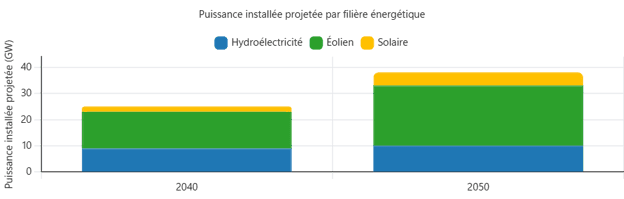
Meeting power needs is a major challenge for Québec, given the significance of consumption peaks, particularly in winter. Additional needs could reach nearly 2 GW by 2030 and approximately 12 GW by 2040, while peak demand could increase to as much as 22 GW by 2050.
To address these needs, the PGIRE relies on a diversified and predominantly renewable energy mix, as well as the maintenance of reliable, sustainable, and modernized infrastructures and networks.
Direction 3: Support the development of renewable energy pathways
The PGIRE reaffirms Québec’s commitment to the development of renewable energies, as current production is not expected to meet projected needs by 2050. Québec will therefore need to increase its electricity supply by 100 TWh and its bioenergy supply by 50 TWh. Forest bioenergy will play a significant role, with a target of approximately 20 TWh by 2050.
The PGIRE also sets intermediate milestones for 2030 and 2040. The deployment of new electricity supplies should reach approximately 15 TWh by 2030 and 60 TWh by 2040, in order to support a trajectory consistent with the 2050 target.
The PGIRE will also have concrete impacts on the planning of regulated distributors.
Direction 4: Place energy availability and the economic benefits of the energy transition at the heart of decision-making
The PGIRE adopts a pragmatic and gradual approach to the energy transition. This approach is reflected in the prioritization of electrification for the most suitable uses, while temporarily maintaining the use of natural gas and petroleum products in sectors that are more difficult to electrify, such as heavy transport and aviation.
The PGIRE also refers to the possibility of electricity exchanges with neighboring grids, including those of other provinces.
Direction 5: Carry out the energy transition at the best cost for society
The PGIRE recognizes that the energy transition will entail significant costs and may place upward pressure on rates in the short to medium term. It nonetheless frames these costs as the necessary counterpart to investments expected to generate substantial economic benefits for Québec.
By 2050, Québec could benefit from an increase of $14.2 billion in economic activity within its territory, while the expansion of energy capacity could reduce energy expenditures for Québec households.
An Enhanced Role for Regulated Distributors
One of the most significant elements of the PGIRE is its direct connection to the planning obligations of distributors. Hydro-Québec will be required to file a 15-year electricity supply plan that is consistent with the PGIRE, while natural gas distributors will remain subject to comparable obligations over a 10-year horizon.
In other words, the PGIRE is expected to influence not only public policy, but also the regulatory and commercial environment in which energy projects are developed, financed, and operated.
Implementation
The PGIRE must be updated every six years, and the government is required to publish a status report on its implementation within six months following the third anniversary of its approval. It may also be revised earlier if exceptional circumstances so warrant.
For businesses active in the energy, infrastructure, industrial, and financing sectors, the PGIRE provides a clear signal as to how Québec’s energy system is expected to evolve, as well as the opportunities, constraints, and regulatory developments that may result.




Stay Connected
All form fields are required "*"