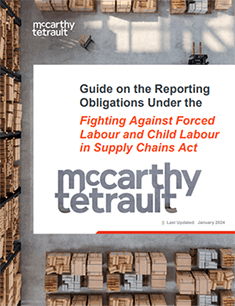
Modern Slavery: A Guidebook on the Reporting Requirements Under the Fighting Against Forced Labour and Child Labour in Supply Chains Act

Canada’s Fighting Against Forced Labour and Child Labour in Supply Chains Act imposes detailed annual reporting obligations on covered entities — with public disclosure, board approval, and potential penalties for inaccurate or misleading statements.
This updated guide (March 2026) provides a structured walkthrough of the reporting requirements, incorporating recent Public Safety Canada guidance and key developments affecting the 2026 reporting cycle. It is designed to help organizations subject to Canada’s Supply Chains Act understand what must be reported, how to approach disclosure, and how to avoid common pitfalls.
Organizations that reported previously will likely need to adjust their approach for 2026.
What’s New for the 2026 Reporting Cycle:
- Updated Public Safety Canada guidance affecting how entities are expected to report
- Clarified guidance on entities solely engaged in selling or distributing goods
- Refined interpretation of “very minor dealings” and de minimis activities
- New expectations around assessing effectiveness, including year‑on‑year progress and goal setting
- A tighter reporting focus on goods and suppliers, including specific sourcing regions
- Introduction of a multi‑jurisdictional reporting template aimed at reducing administrative burden for entities reporting in Canada, the UK, and Australia
Request Your Copy Now
What This Guide Covers
- Key 2026 updates, including revised enforcement guidance and reporting expectations
- An overview of the statutory reporting framework and who is required to report
- Detailed guidance on each of the eight mandatory reporting categories under the Act, with a focus on forced labour and child labour risk
- Practical considerations for addressing forced labour and child labour risks in supply chains
- Insights on policies, due diligence, remediation, training, and effectiveness assessment
- Board approval and attestation requirements, including practical drafting considerations
Who Should Read This Guide
This guide is particularly relevant for:
- In‑house legal, compliance, ESG, procurement, and risk teams
- Directors and officers responsible for approving and attesting to reports
- Canadian and multinational organizations with complex or global supply chains
- Businesses preparing for their 2026 Supply Chains Act filing
Need Support with Your 2026 Report?
Our International Trade & Investment Law Group advises organizations across sectors on Supply Chains Act compliance, risk mitigation strategies, and report preparation. If you have questions or compliance concerns, please reach out to John Boscariol, Martha Harrison, Robert Glasgow, Gajan Sathananthan, or Vino Wijeyasuriyar.
People
 John W. Boscariol
Partner | Co-Head, International Trade and Investment Law
People.Offices.Singular Toronto
 Martha Harrison
Partner | Co-Head, International Trade and Investment Law
People.Offices.Singular Toronto