
Civil Appeals by the Numbers: The Court of Appeal for Ontario Releases a Decade of Data

Key Takeaways:
- Civil appeals take approximately 13 months from filing to decision, with most of that time spent on preparation and scheduling rather than judicial deliberation.
- Only about one in four civil appeals succeeds, underscoring the importance of carefully assessing the merits before appealing.
- Leave to appeal is difficult to obtain, with the Court granting only about 15% of applications in 2024.
- Self-represented litigants appear in nearly one-third of incoming civil appeals, increasing the likelihood that counsel will face unrepresented parties.
- The Court of Appeal continues to modernize, with expanded digital filing and a renewed commitment to annual public reporting.
On July 2, 2026, the Court of Appeal for Ontario released its first annual report in over a decade. The report, covering the period 2023–2024, provides insights on how Canada’s busiest provincial appellate court is functioning and what parties who come before it can expect.
The report also highlights several practical takeaways for parties considering or engaged in an appeal, including how long the appeal process typically takes, how often civil appeals typically succeed, how rarely leave to appeal is granted, the growing presence of self-represented litigants, and the court’s continued move toward digital filing through its new portal.
How Long Do Civil Appeals Take in Ontario?
In 2024, the average time from filing a civil appeal to receiving the decision, for appeals heard and decided on their merits, was 396.66 days, or roughly 13 months. The report illustrates the total length of time for appeals of all types to work their way from filing to decision as follows:
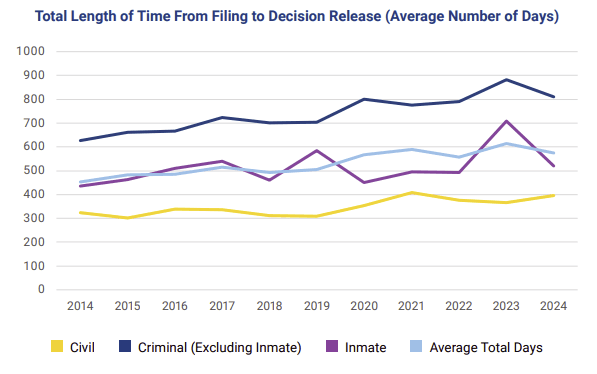
The total appeal timeline breaks down into three distinct phases:
- Filing to scheduling readiness;
- Scheduling readiness to hearing date; and
- Hearing date to release of decision.
Average Timeline for Civil Appeals | 2014 | 2015 | 2016 | 2017 | 2018 | 2019 | 2020 | 2021 | 2022 | 2023 | 2024 |
Between filing an appeal and scheduling readiness | 4.5 | 4.1 | 4.4 | 4.2 | 3.6 | 3.4 | 4.4 | 5.1 | 4.2 | 3.9 | 4.6 |
Between scheduling readiness and hearing date | 4.8 | 4.4 | 5.1 | 5.4 | 5.1 | 5.5 | 5.8 | 6.5 | 6.7 | 6.1 | 6.3 |
Between hearing date and release of decision | 1.5 | 1.6 | 1.7 | 1.6 | 1.6 | 1.3 | 1.4 | 1.8 | 1.7 | 2.0 | 2.1 |
Total (months) | 10.7 | 10.1 | 11.3 | 11.1 | 10.3 | 10.2 | 11.6 | 13.5 | 12.6 | 12.0 | 13.0 |
Table created from data contained in the 2023-2024 Report
In 2024, the average timelines for civil appeals were 140.35 days from filing to scheduling readiness, 191.60 days between scheduling readiness and the hearing, and 65.03 days between the hearing and the decision.
In other words, although civil appeals took, on average, about 13 months to work their way through the Court of Appeal, only about 2 months on average are attributable to the court’s deliberation. The rest is the time taken to exchange materials, coordinate hearing logistics, and get to the courthouse steps.
How Often Do Civil Appeals Succeed in Ontario?
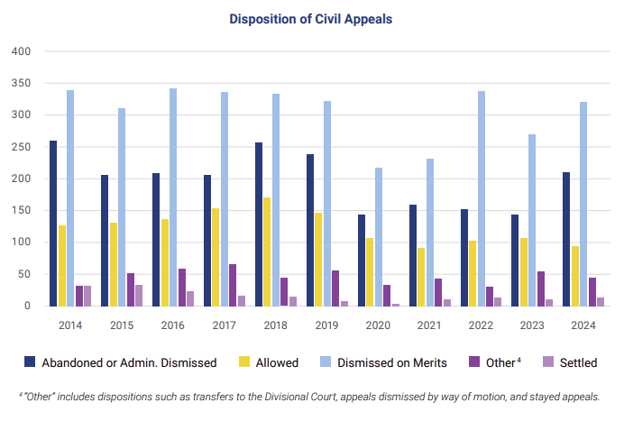
Only 22.7% of civil appeals decided on their merits in 2024 were allowed. This is slightly below the ten-year average civil appeal success rate of 28.85%.
Civil Appeal Outcomes after Hearing on the Merits | 2014 | 2015 | 2016 | 2017 | 2018 | 2019 | 2020 | 2021 | 2022 | 2023 | 2024 |
Appeals allowed | 126 | 131 | 137 | 154 | 170 | 147 | 107 | 92 | 102 | 107 | 94 |
Appeals dismissed | 339 | 312 | 342 | 336 | 334 | 323 | 218 | 232 | 337 | 270 | 321 |
Total | 465 | 443 | 479 | 490 | 504 | 470 | 325 | 324 | 439 | 377 | 415 |
Table created from data contained in the 2023-2024 Report
In 2024, in addition to the 415 civil appeals decided on their merits, 268 civil appeals were resolved in other ways: 210 appeals were abandoned or administratively dismissed, 13 were settled, and the remaining 45 were otherwise disposed of (such as by transfer to the Divisional Court, by a stay, and so on). The court’s report illustrates the trends in these dispositions:
Where Leave to Appeal is Required, Success is Rare
The report underscores another important point for litigants: where leave to appeal is required, obtaining it is difficult. In 2024, 137 motions for leave to appeal were filed, but the court granted only 20 (some of which may have been filed in the prior year). This yields an average success rate of about 15% for civil motions for leave to appeal in 2024.
The Court of Appeal does not typically issue reasons for its leave to appeal decisions. However, in 2024, it broke from tradition — twice.
First, in December 2024, the court released reasons for its decision granting leave to appeal in West Whitby Landowners Group v. Elexicon Energy Inc., 2024 ONCA 910. In West Whitby, the court recalibrated the analytical framework governing applications for leave to appeal from the Divisional Court. It appeared to endorse a more flexible approach and hinted that administrative and public law decisions may be more likely to be granted leave. Learn more about this decision in our post, A New, Flexible Era for Leave to Appeal to the Court of Appeal for Ontario.
Then, exactly two weeks later, the Court of Appeal took a step back. It released reasons for its decision denying leave to appeal in Davis v. Aviva General Insurance Company, 2024 ONCA 944. Justice Sossin, writing for the panel, explained that despite West Whitby, “the principles governing leave applications have not changed.”
The impact, if any, of the court’s unusual leave to appeal decisions in late 2024 is not yet reflected in its published data. It will be interesting to see how the number of motions for leave to appeal filed (or granted) may differ in future years, following West Whitby and Davis.
The Rise in Self-Represented Litigants
The report points to an increase in the presence of self-represented litigants in the Court of Appeal. In 2024, 181 incoming civil appeals involved a self-represented litigant, representing approximately 32.44% of the court’s incoming civil appeals. This is a significant increase compared to the past decade:
Incoming Appeals with Self-Represented Litigants | 2014 | 2015 | 2016 | 2017 | 2018 | 2019 | 2020 | 2021 | 2022 | 2023 | 2024 |
Self-Represented | 26.64% | 24.39% | 23.29% | 24.35% | 22.71% | 24.93% | 21.35% | 25.12% | 21.64% | 25.78% | 32.44% |
Represented | 73.36% | 75.61% | 76.71% | 75.65% | 77.29% | 75.07% | 78.65% | 74.88% | 78.36% | 74.22% | 67.56% |
Total Civil Appeals Filed | 777 | 824 | 760 | 764 | 731 | 718 | 473 | 641 | 633 | 609 | 558 |
Table created from data contained in the 2023-2024 Report
The practical reality is that counsel are more likely now than before to find themselves opposite a party who is unrepresented. The Court of Appeal’s civil practice direction contains a real example of how the court is responding to this trend. In motions involving a self-represented litigant, parties are encouraged to schedule the hearing for a Wednesday or Thursday, when Pro Bono Ontario duty counsel are available to assist self-represented parties.
The Court’s New Portal is Part of a Broader Modernization Effort
Finally, the report highlights the court’s embrace of digital transformation. Electronic filing has expanded significantly during and after the pandemic, and the court replaced its case management system with C-Track in 2022 to streamline workflow across departments. The report also anticipates the new public filing portal, which has since launched in April 2026. These efforts reflect a broader shift towards accessibility, transparency and a more modern court system.
What’s Next?
Chief Justice Tulloch’s message is clear: the court has reaffirmed its commitment to reporting regularly about its work and, going forward, it will publish a report every year. This is a welcome development. Annual reports will deepen public understanding of the court’s work, strengthen confidence in the justice system, and give parties and counsel a clearer view of how appeals move through the court.

Stay Connected
All form fields are required "*"