
Key Takeaways from McCarthy Tétrault Tax Perspectives: September 2026

In September 2026, during the McCarthy Tétrault Tax Perspectives tour, members of our National Tax Group had the opportunity to provide participants with an overview of our evolving Canadian tax landscape and provide attendees with strategic insights and actionable advice.
The discussion focused on recent legislative amendments to the Income Tax Act (Canada) (the “ITA”), including the Draft Legislative Proposals released by the Department of Finance (“Finance”) on July 23, 2026 (the “July 2026 Proposals”) and the Draft Legislative Proposals implementing the Productivity Mega Deduction released by Finance on September 15, 2026 (the “Mega Deduction Proposals”).
July 2026 Proposals – Proposed amendments to the definition of “taxable Canadian property”
The proposed amendments to the definition of “taxable Canadian property” (“TCP”) included in the July 2026 Proposal deserve particular attention. While at first glance the changes may not appear significant, the implications of the proposed changes may be extremely meaningful in real-world circumstances.
There are three proposed changes to the definition of “taxable Canadian property” in subsection 248(1) of the ITA.
First, publicly traded partnership units will now be treated in the same manner as shares that are listed on a designated stock exchange.
Second, the rules in paragraph (d) governing the TCP status of shares of a private corporation would be amended to change the basis on which it is permissible, in determining the TCP status of shares of a particular corporation or units of a particular partnership, to look through the shares of a subsidiary corporation or units of a subsidiary partnership of the particular corporation or partnership (the “subsidiary”) to the subsidiary’s underlying property from which it indirectly derives its value. The current rules only permit such look-through where equity of the subsidiary are themselves TCP. The July 2026 Proposals, if enacted, will permit the look-through in all circumstances, except where the equity of the subsidiary is listed on a designated stock exchange. In some cases, this proposed amendment significantly broadens the look-through rule in paragraph (d), as illustrated in the following example:
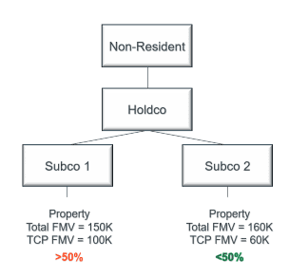
This example assumes that the shares Subco 1 and Subco 2 are not listed on a designated stock exchange. The shares of Subco 1 are TCP, (because more than 50% of their value derives from TCP), but the shares of Subco 2 are not TCP.
Under the current rules, the shares of Holdco would not be TCP because in making that determination, we only look through the shares of Subco 1. The fair market value (“FMV”) of Holdco is $310,000, only $100,000 (<50%) of which is derived indirectly from TCP.
The proposed amendments would look through all of the Subco shares unless those shares are listed on a designated stock exchange. In this case $160,000 of Holdco’s $310,000 FMV would be derived from TCP, thus the shares of Holdco would be TCP.
In other circumstances, the amendments to paragraph (d) narrow the scope of the definition of TCP, such as where shares of a subsidiary listed on a designated stock exchange derive more than 50% of their FMV from TCP, as illustrated in the example below.
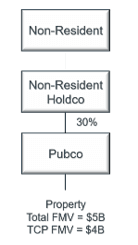
In this case, under the current rules, the shares of Non-Resident Holdco would be TCP of its Non-Resident parent because under paragraph (e) of the TCP definition, Non-Resident Holdco owns more than 25% of the shares of Pubco and more than 50% of the FMV of the shares of Pubco derive from TCP. The shares of Non-Resident Holdco would be TCP to Non-Resident, because on a look-through basis more than 50% of the FMV of its property derived from TCP. Under the proposed rules, there is no look-through in respect of the Pubco shares, and therefore the shares of Non-Resident Holdco held by Non-Resident are not TCP.
Finally, another significant change is in the treatment of options, rights and interests in certain properties (hereinafter collectively referred to as “options”) are treated under the TCP definition. Under the existing rules, options were relevant in two circumstances:
- in paragraph (f) as a separate category of TCP if the option was in respect of any properties described in paragraph (a) to (e) of the TCP definition; however the options would not be aggregated with the properties described in (a) to (e) for the purposes of the definition, such that for the purposes of subparagraph (e)(i), in determining whether a person held 25% or more of the shares of any class of a corporation listed on a designated stick exchange, once could hold 24% of the shares of a class and an option to acquire an additional 1% of the shares of the same class without meeting the 25% threshold, and
- in testing the FMV of the underlying property of a private corporation in subparagraph (d)(iv), or of a public corporation pursuant to subparagraph (e)(ii).The proposed definition of TCP repeals paragraph (f) and removes the references to options in testing the underlying property of a private or public corporations. Instead, proposed subsection (1.2) introduces a new rule that deems a property described in paragraphs (a) through (e) to include an option, right, or interest in respect of the property, whether or not the property exists. The technical notes accompanying proposals make it clear that this deeming provision is intended to broaden the treatment of options for the purposes of the TCP definition, and that in the example above, a taxpayer who owns 24% of the shares of a class of a public corporation and also holds an option to acquire an additional 1% of the shares of that class would meet the 25% ownership test under subparagraph (e)(i).
Legislative amendments and proposals
1. Productivity Mega Deduction
The Productivity Mega Deduction, announced on September 15, 2026, will provide for the immediate expensing of a broad range of depreciable properties on a permanent basis. This deduction will reduce Canada’s marginal effective tax rate or METR (measured as the tax imposed on an additional dollar of business investment) to 6.4%. The Productivity Mega Deduction is intended to boost business investment, enhance certainty and simplicity for businesses and strengthen Canada’s tax competitiveness.
The Productivity Mega Deduction is intended to be permanent, and will apply to depreciable capital property subject to the capital cost allowance (CCA) rules, that is acquired on or after September 15, 2026, with some exclusions (e.g. buildings included in CCA classes 1 and 3, franchises, licenses, goodwill, certain passenger vehicles and regulated natural gas distribution pipelines). The Productivity Mega Deduction will also apply to eligible Canadian development expenses (“CDE”) incurred on or after September 15, 2026, including an amount that is deemed to be CDE of a taxpayer because it is renounced under a flow-through share agreement entered into on or after September 15, 2026.
Eligible property must generally be “new” property (meaning that the property (i) has not been used for any purpose before it was acquired by the taxpayer, and (ii) and no amount has been deducted as CCA or a terminal loss in respect of the property). However, a property that was used or acquired for use for any purpose, before a taxpayer acquired it, may be eligible for immediate expensing where:
- neither the taxpayer nor a non-arm’s length person previously owned the property; and
- the property has not been transferred to the taxpayer on a tax-deferred (rollover) basis.
Immediate expensing for Class 47 liquefaction equipment used in liquefied natural gas (“LNG”) facilities will be achieved through an additional allowance that increases the CCA rate for that property to 100%(up from the 50% rate proposed in the Spring Economic Update 2026).. This allowance may only be claimed against income attributable to natural gas liquefaction activities carried out at that particular facility.
The 10% accelerated CCA rate announced in the Spring Economic Update 2026 for Class 1 non-residential buildings used in LNG facilities will continue to apply.
LNG facilities will not be required to satisfy the expected emissions intensity requirements proposed in the Spring Economic Update 2026 to qualify for either immediate expensing for Class 47 liquefaction equipment or the accelerated CCA for eligible Class 1 non-residential buildings.
Property that does not qualify for the Productivity Mega Deduction may still qualify for the Productivity Super-Deduction, including the reinstated Accelerated Investment Incentive announced in the 2025 federal budget.
For more information on the Productivity Mega Deduction please see “Productivity Mega Deduction: Key tax measures announced at the Canada Investment Summit.”
2. CRA enhanced audit powers – Bill C-31
The 2024 Budget proposed significant amendments to the CRA’s information gathering powers under the ITA, including:
- the ability of the CRA to issue a Notice of Non-Compliance (“NoNC”), which suspends the normal reassessment period for all issues and all non-arm’s length parties until the Minister is satisfied that the information requested has been provided;
- an automatic penalty of $50 per day that the NoNC is outstanding;
- a requirement that information or documents be provided by taxpayers under oath or affirmation; and
- a compliance order penalty equal to 10% of the aggregate tax liability for the taxation years to which the order relates (where the tax liability exceeds $50,000).
Draft legislation released in August 2025 introduced some taxpayer-friendly amendments, including an exception for failure to comply with a NoNC where the taxpayer reasonably believed the information was protected by solicitor-client privilege, discretion to the CRA’s power to impose a compliance order penalty, and the introduction of a proportionality requirement for penalties.
Discussion of the 2025 draft legislation was included in the Q1 Tax Tour, for more information please see “Key Takeaways from McCarthy Tétrault Tax Perspectives: January and February 2026.”
On May 4, 2026, the government introduced Bill C-31 (Budget 2025 Implementation Act, No. 2), which included additional changes to the CRA’s enhanced audit powers, including:
- the removal of the requirement that taxpayers provide information under oath or affirmation;
- compliance order penalties limited to 10% of the aggregate tax payable by a taxpayer for each year, with discretion to waive the penalty where the CRA determines that it is disproportionate or unfair (though it in unclear which criteria the CRA will use to make that determination);
- the Minister must obtain a compliance order when seeking information from a third party in relation to an unrelated person;
- demands for foreign-based information are subject to the NoNC regime, and can be enforced through compliance orders; and
- the rule that deems a vacated NoNC to have never been sent or served does not apply for the purposes of the rule deeming a taxpayer’s normal reassessment period to be suspended while a NoNC is the subject of a judicial review.
3. July 2026 Proposals – Transfer pricing updates
The July 2026 Proposals included proposed Regulations implementing simplified documentation requirements contemplated by new subsection 247(4.1).
New subsection 247(4.1) states that the contemporaneous documentation requirements in subsection 247(4) may not apply where the taxpayer (or partnership), for a particular taxation year or fiscal period in respect of a transaction, (i) meets the prescribed conditions, and (ii) makes, obtains, and provides prescribed documentation in the prescribed manner.
The simplified documentation requirements may apply in the following circumstances (where the taxpayer or partnership elects for subsection 247(4.1) to apply):
- To “small” taxpayers or partnerships, that is taxpayers or partnerships with a total gross revenue (of the taxpayer, partnership and any other resident member of a multi-national entity group to which the taxpayer or partnership belongs) for a prior taxation year of $25,000,000 or less, provided that;
- the taxpayer (or partnership) did not dispose of intangible property to non-arm’s length non-residents; and
- the taxpayer did not pay royalties to, or receive royalties from a non-arm’s length non-resident.
- The purchase of tangible property if the amount paid is $2,000,000 or less.
- The receipt or provision of services if the amount paid is $2,000,000 or less.
- The borrowing or lending of money if interest paid during the year or period is $1,000,000 or less.
Where the requirements in the proposed Regulations are met, the taxpayer or partnership is deemed to satisfy the “prescribed conditions” in new paragraph 247(4.1)(a) of the ITA, and the more cumbersome contemporaneous documentation requirements in subsection 247(4) should not apply.
Under the simplified documentation rules, records or documents must provide an accurate description of the terms and conditions of the transaction, including the identity of the participants, the relevant property, services or details of the loan, and the amounts paid or payable. The documents must also provide an accurate description of the analysis undertaken to determine whether the amounts reflect arm’s length conditions, and, where simplified filing is made in respect of a “small” taxpayer or partnership, a calculation of the total gross revenue of the taxpayer, partnership, or any other resident member of the multinational enterprise to which the taxpayer belongs for the prior period or year.
Although the simplified documentation regime explicitly exempts eligible taxpayers and transactions from the more cumbersome documentation requirements of subsection 247(4), it is unclear whether this represents a reduction in compliance burden compared with past practices. Taxpayers and their advisers have always taken a more pragmatic approach to simple, low-value transactions, and the CRA has long endorsed streamlined documentation for these types of transactions. In its published guidance (Transfer Pricing Memorandum TPM-09: Reasonable Efforts under section 247 of the Income Tax Act, September 18, 2006), the CRA states that “when preparing documentation, taxpayers should attempt to assess the significance of the transactions in relation to their business in terms of the additional administrative costs involved” and, consequently, that “taxpayers are not required to go beyond what is reasonable in terms of documentation.” It is unclear whether taxpayers who took advantage of the CRA’s administrative practice set out in TPM-09 will now be required to file an election under subsection 247(4.1) to continue benefitting from this practice.
4. July 2026 Proposals – Foreign Accrual Property Income (“FAPI”) and provision of services
Paragraph 95(2)(b) of the ITA is an anti-base erosion rule that deems the provision of services by a foreign affiliate of a taxpayer (the recipient affiliate) to be a separate business other than an active business (thus generating FAPI), to the extent that amounts paid or payable for the services are deductible in computing either:
- income from a business carried on in Canada by certain taxpayers, or
- FAPI of another foreign affiliate of the taxpayer.
The tax policy objective of the rule is to ensure that income that would otherwise be taxed in Canada as business income or FAPI of the payor is not converted into active business income through payments to the recipient affiliate. Fairness concerns were raised with Finance in the context of an asset management business, where it is not unusual for fund sponsors to hold a minority stake in the funds they manage.
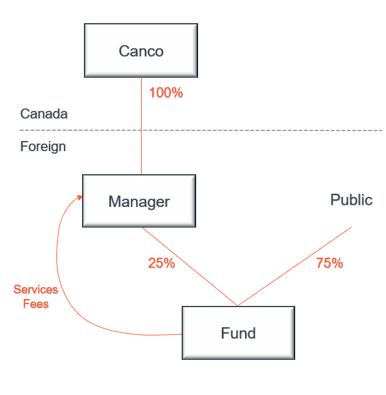
In this scenario, where service fees are deductible by the Fund in computing FAPI, the investment management business carried on by the Manager is deemed to be a business other than an active business and all the income that the Manager derives from the provision of those services is included in its FAPI, notwithstanding that most of the interests in the Fund are held by arm’s length third parties.
Amendments to the FAPI rules to address this situation were first proposed in a comfort letter issued by the Department of Finance in 2017, and legislative proposals were published in 2022. The July 2026 Proposals provide additional clarification in determining the apportionment of income: instead of treating all of the management fees earned by the Manager as FAPI, only the portion of the income corresponding to Canco's interest in the Fund should be recharacterized as FAPI under paragraph 95(2)(b).
The rule applies retroactively to taxation years of a foreign affiliate that begin after 2015.
5. July 2026 Proposals – Hybrid mismatch rules
The July 2026 amendments also introduce proposed changes to the hybrid mismatch rules. Some highlights include:
- Thin-Capitalization Ordering Rule: the thin-capitalization rule in subsection 18(4) has been amended to now apply in priority to the hybrid mismatch rules. This amendment was the result of concerns expressed by the CBA/CPA Joint Committee on Taxation (the “Joint Committee”) that taxpayers would structure their affairs to fall into the hybrid mismatch rules first, to avoid the withholding tax that would be payable on the deemed dividend arising from interest denied by under the thin-capitalization rules.
- Deemed Dividend Rule: the January 2026 draft legislation drastically expanded the circumstances in which denied interest could be recharacterized as a dividend for Part XIII purposes. The July 23, 2026 draft legislation reverses this approach such that the deemed dividend treatment will remain limited to certain hybrid financial instrument arrangements introduced in the first package of hybrid mismatch rules.
- Hybrid Payor Rules for Double Deductions: the amendments address how mismatches are measured, and introduce rules for the valuation of dual inclusion income.
- Reverse Hybrid Arrangements: the amendments expand the conditions for “reverse hybrid arrangements”, including a revised relationship test expected to capture more circumstances involving investors in reverse hybrid entities.
- Updated Explanatory Notes: updated guidance clarifies certain concepts, including the meaning of “foreign hybrid payor,” “residence,” “hybrid entity” and the definition of “ordinary income.”
The July 2026 Proposals do not change the policy direction of the hybrid mismatch rules, and respond to a number of the joint committee suggestions. Some committee suggestions remain unaddressed, including the effective date of the rules, July 1, 2026.
Discussion of the Hybrid Mismatch Rules was included in the Q2 Tax Tour, for more information please see “Key Takeaways from McCarthy Tetrault Tax Perspectives: May 2026.”
Recent Cases of Interest
We reviewed a number of recent Canadian tax cases of interest, including:
1. Vefghi Holding Corp. v. R., 2026 CanLII 79352 (SCC) – when are corporations are “connected” through a trust.
For further comments on Vefghi, please see our article “Top 10 Need-to-Know Canadian Income Tax Cases from 2025”.
2. Harvard Properties Inc. v. Canada, 2026 FCA 142 – whether unrelated parties to a transaction deal at arm’s length for the purposes of section 160 of the ITA – application of the general anti-avoidance rule (the “GAAR”).
3. Hunt v. Canada, 2026 FCA 88 – statutory interpretation principles in the tax context.
4. Canada v. Martin, 2026 FCA 144 – application of section 115 to employment benefits of a non-resident performing services in Canada.
5. STC Steel Technologies Canada, Ltd. v. R., 2026 TCC 149 – foreign currency conversion in the context of subsection 261(16).
6. Bénard c. R., 2026 CCI 152 – application of the replacement property rules to property re-acquired by a taxpayer.
7. Chobham Corporation Ltd. v. R., 2026 TCC 127 – Availability of Québec abatement to a non-resident trust deemed resident in Canada and in Québec.
8. Somerset Limited v. R., 2026 TCC 123 – Non-CCPC planning.
9. Kruivitsky v. R., 2026 TCC 141 – Deductibility of legal expenses incurred on behalf of another person, for the purposes of paragraph 60(o).
10. Liu v. R., 2026 TCC 126 – scope of amended subsection 152(9), and limits on the CRA’s ability to raise new arguments.
11. Desjardins Sécurité financière Compagnie d’Assurance Vie c. R., 2026 CCI 109 – jurisdiction of the Tax Court of Canada where provincial statute incorporates provisions of the ITA by reference.
12. Wilson 555 Avenue Inc. v. R., 2026 TCC 104 – change in use of real property.







Stay Connected
All form fields are required "*"